
Don’t Compromise – solve Dilemmas intelligently

by Finn Majlergaard | 8. Apr, 2025 | Blog, blog posts on creating great corporate cultures

Share this content

Politicians use it all the time, Business executives use it, Parents use it too - the word; compromise.

We learn to compromise because we are told this is what we have to do when different values or interests collide. And we are proud when we have managed to seek a compromise whether it is in politics, at work or at home. In this short article I will argue that the whole idea of the compromise being a good thing is wrong. I will argue that the only reason we end up in compromises is because we don't know better or we don't have the power to reinforce our own will.

A compromise is probably the worst possible solution to a conflict

Very few people enjoy being in a conflict, so most of us are trying to get out of that situation as quickly as possible. This is because we are driven by a negative motivation (getting out of an unpleasant situation) rather than a positive motivation (lets see how we can leverage from the diversity). Because the motivation is negative we accept far from ideal solutions - usually poor compromises.

But compromises are bad - really bad actually.

Firstly none of the parties involved in the conflict get what they originally wanted, so there is a built-in dissatisfaction in a compromise. That is why we can hear politicians and business executives say that it was the best they could achieve. The truth is however that the results they achieve are not limited by the situation but solely by the level of cultural intelligence of the facilitator or leader.

Secondly; compromises are rarely sustainable because each of the parties will use any given opportunity to improve their position whenever it is possible. That means you can never truly rely on your partners in a compromise.

Thirdly; solutions, which are results of compromises are often much less effective than if one of the parties involved had it done his or her way. That is particular true in politics.

There is no alternative to a compromise

Wrong! You might not know it but it is there. It is called reconciliation and it differs from a compromise in that it  builds on the strengths of the  commonalities instead of weaknesses of the differences. But in order to be be able to reconcile you need to have a fairly high level of cultural intelligence. You need to be able to understand views opposing your own views. You need to be able to produce arguments that goes against you own point of view and finally you need to be creative and patient.

Over the years Gugin has facilitated  hundreds of reconciliation processes often in situations where an organisation was on the edge of disintegration.  All the cases  we have worked with have a few things  in common namely that the parties involved either had given up, was hoping for a miracle to happen or working towards a compromise.

If you are in a conflict you can achieve a compromise with the other party because of the reasons mentioned above. If however you want to pursue a reconciliation it is almost impossible to achieve that without an external facilitator who is not emotionally involed in the conflict. Furthermore the external facilitator will move the process forward even when it is painful and you might be tempted to give up.

When a reconciliation has been completet successfully that parties involved are often very happy, full of energy and most importantly they are committed to work together because they have achieved something they didn't think was possible.

An example

Most of the conflicts we help reconciling are rooted in differences between different departments in the same company; for instance between between the product development and sales departments.

A typical conflict in that situation is a discussion about who is most important - who is the dog and who is the tail. The product development partment will claim that they are the most important ones and therefore should have most influence. Without them there would be no products to sell. The sales people will claim they are the most important ones because they develop the market and make the sales even if the products are far from world class.

A conflict like that usually start as a friendly teasing, but it can easily escalate into regular fight between the departments, which eventually can take down the company. If the company was founded by engineers who came up with the idea for the product it is likely that the senior management will support the product development side in the conflict. Nokia is a good example of suct a company. When sales started to decline for Nokia it took them too long to realise what was going on primarily because the product development departments wouldn't listen to the feedback they received from Nokia sales organisation.

The usual compromise

When a conflict like that escalates the senior management team usually try to seek a compromise in order to resolve the conflict. The compromise is usually either a change in the tier 2 management level, finansiel compensation, promises that things will change or focus groups with the purpose to improve collaboration and communication.

Needless to say that any of these initiatives solves the problem or brings the company in a better position, but it is as good as it gets when you only see the compromise as the solution.

The solution Gugin proposes

When a company or organisation asks us to help them we first identify the rebels. Most people don't like rebels, but we love them. We love them because the have passion, emotions and courage enough to speak up. If for instance the sales director in a company is complaining a lot and challenges the senior management team it is probable because he loves the company and is willing to fight for it to suceed. If he was unhappy with the company he would just leave. That is why it is so important to identify and listen to the A-performing rebels in an organisation.

Going back to the chosen case.

We start by facilitating a session where all the parties involved are asked to focus on what they have in common and which common goals they have. That exercise changes the mindset completely because until this point they have only been focused on pointing out the differences.

The we will ask the product development to outline the best things about the sales department. We do a similar exercise with the sales department.

We then educate the people involved why we react as we do and they gradually develop a higher level of cultural intelligence. When you have achieved a certain level of cultural intelligence you react in a different way when other people behave in a way you don't like. you be come curious and open-minded instead of prejudiced.

Then we will talk to the product development people and ask them which resources they need in order to develop new products that the market will like. They will of course say money as one of the factors. Then they will realise that the only way they can get more money is if the sales people can sell more.

When we ask the sales people what they need in order to sell more they will say outstanding products at the right time as one of the most important factors.

The two groups will become aware that they are dependent upon each other and it is not a question about who is wagging who. When there is an agreement about that everyone is on the same side of the table we can move on. Not towards a compromise but towards something much more fruitful.

The product development people need more money but they also need signs at an early stage about what is wanted in the marketplace. The sales people can provide that intelligence. When the product development department received the intelligence early they can bring new right products to the market much earlier and get a bigger market share. That leads to an increased profitability and a closer collaboration between the different departments in the company because they have seen the positive results of working together.

This is in rough terms what we do when we help companies improve performance and change the corporate culture.

If you want to learn more please read here: https://gugin.com/organisational-effectiveness/ and feel free to contact us for a confidential conversation about how we can assist you. Please write to gugin@gugin.com
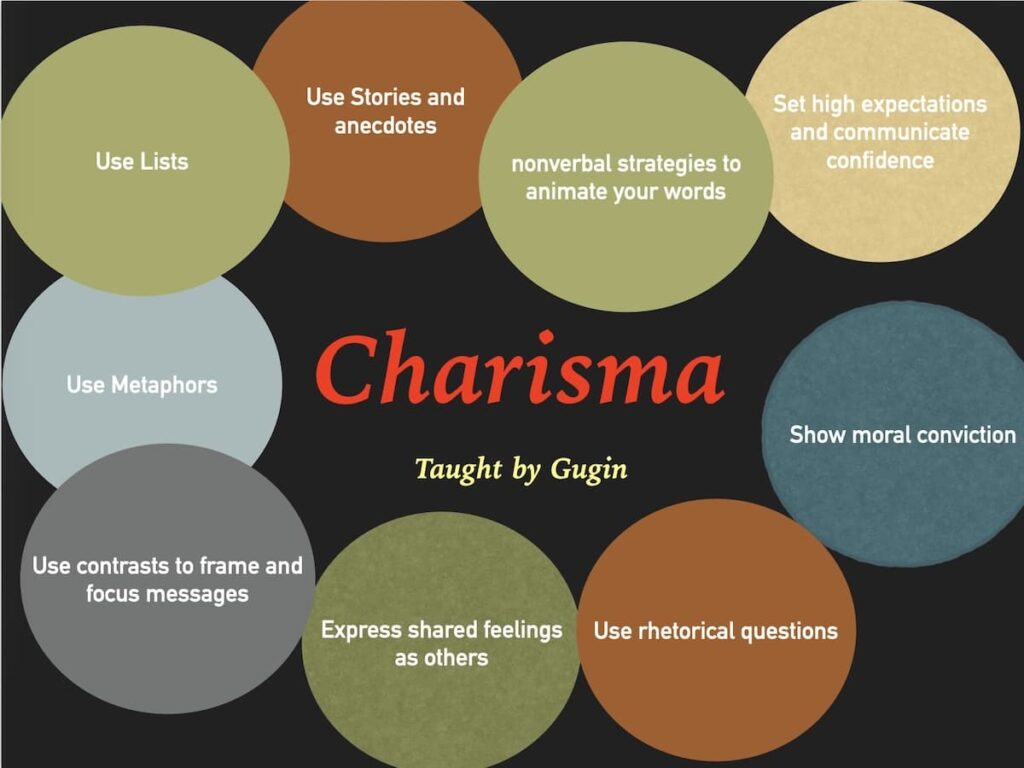


What separates a good leader from one who truly moves people? Research — and decades of cultural intelligence practice — point to one word: charisma. And unlike talent, charisma can be learned.

In 1979, Warner Records refused to send Prince on tour. Not because of his music — they knew he was exceptional — but because he lacked charisma. He couldn't yet move an audience. Fast forward one year, and Prince had transformed himself into one of the most commanding performers in the history of popular music. He didn't wait for charisma to arrive. He worked at it, systematically, studying and adopting the techniques of the performers he admired.

That story is not just about rock and roll. It is a precise metaphor for leadership. At Gugin, we have spent over two decades helping leaders across cultures and industries make exactly this kind of transformation — not by telling them to "be more confident," but by equipping them with concrete, learnable strategies rooted in emotional intelligence, cultural intelligence, and communication science.


Why Most Charisma Advice Fails

The most common advice leaders receive about charisma is frustratingly vague: project confidence, be warm, be present. These qualities do matter. But they are nearly impossible to "just do" on command, especially under pressure, across cultures, or in unfamiliar organisational contexts.

Research by Professor John Antonakis and his colleagues at the University of Lausanne Business School has shown that charisma is not a personality trait reserved for the few — it is a set of communicative behaviours that can be identified, taught, and practised. In their studies, randomly selected middle managers who underwent structured charisma training were subsequently rated by peers and subordinates as more charismatic, more competent, and more trustworthy. The training worked.

At Gugin, we have built on this science and gone further — weaving it together with emotional intelligence (EQ) and cultural intelligence (CQ) to create a leadership development approach that is both evidence-based and globally applicable.

The Nine Charismatic Behaviours — And What They Really Require

The Antonakis research identifies nine concrete charismatic leadership tactics: using metaphors and stories, showing moral conviction, expressing shared feelings, setting high expectations, using contrast and rhetorical questions, using lists, and animating communication with body language. These are the building blocks. But building blocks need a foundation — and that foundation is emotional and cultural intelligence.

Take metaphors, for example. A metaphor is only powerful if it resonates with the audience. In Gugin's cross-cultural leadership programmes, leaders quickly discover that a metaphor drawn from American sports culture may fall flat in a team from Northern Europe, and that a story invoking individual heroism may alienate a collectivist audience in East Asia. The charismatic tactic is the same; the cultural calibration is everything.

The same applies to moral conviction. Appealing to shared values is one of the most potent charismatic tools a leader has. But whose values? Which moral frameworks? A leader operating across multiple cultural contexts must understand that concepts like fairness, loyalty, duty, and hierarchy carry profoundly different weight in different cultures. High cultural intelligence — the ability to read, respect, and adapt to cultural difference — is what allows a leader to express genuine moral conviction that actually connects rather than alienates.

Emotional Intelligence: The Inner Architecture of Charisma

Charisma without emotional grounding is performance. It can work in the short term, but it rarely sustains trust. The leaders Gugin works with are taught to understand that emotional intelligence is not a soft supplement to charismatic leadership — it is its inner architecture.

Consider the tactic of expressing shared feelings. Antonakis identifies this as key: when a leader says "I feel the same uncertainty you do, and here is how I am holding it," they build identification and trust. But this requires real self-awareness. Leaders must be able to name and regulate their own emotional states before they can credibly reflect the emotions of others. In Gugin's programmes, we invest significant time in developing exactly this capacity — helping leaders identify their emotional triggers, understand how their inner states broadcast outward, and build the emotional vocabulary needed to communicate with authenticity.

Empathy — a core dimension of emotional intelligence — also directly underpins several charismatic behaviours. Setting high expectations while simultaneously communicating belief in others (another of the Antonakis tactics) requires a leader who genuinely sees the potential in the people around them. That kind of seeing is empathic. It cannot be faked over time. When Prince produced the band The Time for Warner Brothers, he did not simply demand excellence — he made each member believe they were capable of more than they thought. That is emotionally intelligent leadership in action.

Cultural Intelligence: Charisma That Travels

One of the most important — and most overlooked — dimensions of charismatic leadership in today's world is its cultural portability. A leader who is magnetic in one cultural context may be perceived as arrogant, shallow, or inappropriate in another. This is not a flaw in those audiences. It is a signal that charisma, like all communication, is culturally embedded.

Gugin's work in over 60 countries has shown us that the nine charismatic tactics are universal in their structure but must be culturally adapted in their expression. Rhetorical questions, for instance, invite participation and create anticipation — but their delivery must match the power-distance norms of the audience. In high-hierarchy cultures, a rhetorical question from a senior leader may silence a room rather than energise it. In low-hierarchy cultures, it may spark exactly the engagement intended. Cultural intelligence tells the leader which dynamic they are working in, and how to adjust.

Similarly, the use of storytelling — one of the most powerful charismatic tools — varies enormously across cultures in terms of what stories are appropriate, how direct or indirect they should be, and what kinds of protagonists resonate. Gugin teaches leaders to build a culturally diverse repertoire of stories and to develop the sensitivity to know which story belongs in which room.

How Gugin Trains Charismatic Leaders

Gugin's leadership development programmes integrate the science of charismatic communication with structured development in emotional and cultural intelligence. The process is iterative and experiential, not theoretical.

Leaders begin by gaining honest self-awareness: understanding how they are currently perceived, what emotional signals they project under pressure, and how their default communication style reads across cultures. This foundation phase often surfaces important blind spots — the technically brilliant executive who speaks too abstractly to inspire, the empathetic manager whose conflict-avoidance reads as a lack of conviction.

From there, leaders move into skill-building: practising charismatic communication tactics in safe, structured environments with real feedback. They learn to craft metaphors that carry cultural resonance, to tell personal stories that build connection without oversharing, to use contrast and rhetorical structure to sharpen their message. They receive coaching on non-verbal communication — the body language, vocal variety, and presence that Antonakis identifies as essential to bringing charisma alive.

Finally, leaders apply these skills in live contexts, with coaching support, and receive 360-degree feedback that tracks their progress. This mirrors the approach Antonakis found to be effective — group training combined with individual coaching — and embeds it within the broader cultural and emotional intelligence framework that makes the development durable and globally relevant.

Charisma as a Leadership Responsibility

There is a deeper point worth making. Charisma is not about making yourself more impressive. At its best, it is about making others feel seen, energised, and capable of more than they believed. It is about communicating in a way that bridges difference, builds shared purpose, and creates the conditions for people to do their best work.

In a world where leaders must navigate unprecedented complexity — technological disruption, geopolitical volatility, multi-generational and multicultural workforces — the ability to communicate with clarity, conviction, and emotional resonance is not optional. It is a strategic capability.

Prince didn't work on his charisma because he wanted to be famous. He worked on it because he knew, instinctively, that the music mattered — and that without the ability to connect, the music would never reach the people it was meant for.

The same is true of leadership. The work matters. Charisma is what carries it across.


About Gugin  |  Gugin is a global advisory firm specialising in cultural and emotional intelligence. We help organisations build the leadership capability to thrive in a complex, multicultural world. Learn more at www.gugin.com

error: Content is protected from theft