

It happens all the time - we screw up a business meeting. We have an important business meeting coming up (first meeting with mother-in-law included) and we need it go well. We are well-prepared. We know all the numbers forward and backwards, we have our sales pitches ready, we are prepared for all sorts of questions. What can possibly go wrong?
If you have a little smile on your face now you have probably been in that situation or you know somebody who has. Gugin facilitated a cultural intelligence workshop for a sales organisation last week and one of the pre-workshop questions was "How often have you screwed up a business meeting because of your own lack etiquette and cultural intelligence?". We formulated the question a little differently.
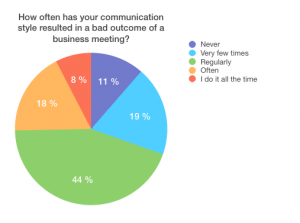 As you can see from the answers in the chart to the left it is very few people who haven't tried saying something, doing something or misinterpreting something that lead to an unsuccessful ending of the business meeting. In this article we will turn it around and outline what you have to do to successfully screw up a business meeting. It does of course serve a purpose doing it this way. When you reverse it it stimulates your creative thinking, which is not bad at all.
The sales organisation that provided the answers is a culturally diversified organisation with an average experience level of 3 years. They sell advanced technological equipment in a highly competitive market. The average lead time is 3 months primarily because of the complexity, investment size and customisation options.
Why do we screw up a business meeting?
Given the amount of time and money we spend preparing these meetings and the level of importance many of these meetings have we should do whatever it takes to make them successful. And that is exactly what we are doing - we think.
The problem is we can only prepare for things that are conscious to us or things we can imagine. But how do we tackle all the things we can't see, feel,hear, measure or imagine? Some people will claim that there is nothing beyond what they can imagine. These people will refuse any idea or proposal that lies beyond their imagination.
When a person with these characteristics prepare for a business meeting he or she will usually assume that the other people participating in this meeting will be just like him or her. So the preparation is usually concerned about facts, stratetic and tactical issues, decision parameters and things like that.
Johari Window
The famous quote by Socrates; "Wise is the man who knows he knows nothing" is a quote we should all have on top of our mind all the time because it in a very subtle way reminds us about our own limited intellectual capacity. Another 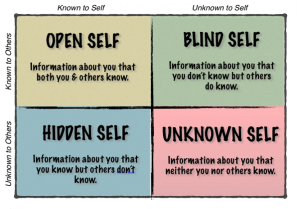 important technique to help yourself to expand your imagination and awareness is the Johari Window. You can see it here on the right. It is a technique to illustrate what is visible to yourself and what is visible to others. In Gugin we use that a lot when facilitating our cultural intelligence workshops, but you can use it in many other contexts.
We are all different so what you might want to keep hidden others might want to talk about openly. Some want to talk about their salary, others find that a private matter. Some want to talk about their sexual, political or religious preferences, while these subjects are private to others. So there are plenty of opportunities to insult other people if you are not aware of these differences.
Some people are more culturally blind than other, but we can all improve. And elevating our social and cultural competences benefits everybody.
- You become more successful in business.
- You team will work much better together.
- You can respond much quicker and more open-minded to changes in the world around you.
[et_bloom_inline optin_id=optin_4]
How to screw up a business meeting - beginners guide
- Assume everybody else are just like you. And if it turns out NOT to be the case you will willingly educate other people so that they understand your views, opinions and values are the right ones
- Time is money, so if you do all the talking yourself the meeting will be over quickly. You are after all well-prepared so there isn't that many things to discuss
- Some years ago someone told you how important it is with an ice-breaker, so you always open a meeting with a couple of jokes and Dilbert cartoons. Unfortunately the other people in the room don't have any sense of humour because they never laugh when you are done. Never mind. Just go on - someday, somewhere there will eventually be a person laughing at your jokes. Never lose faith!
- Someone also told you about cultural differences so you have bought a quick guide to the country where your business partners are coming from. It is filled up with cultural stereotypes in bullet lists. just what you need.
Now that you know how to screw up a business meeting you also know what to do. We are at your service - anywhere in the world
Want to screw up less meetings?

I just say things as they are…
I just say things as they are – is a phrase we often hear. It reveals that the person saying it has very low cultural and emotional intelligence

Cross-Cultural Team Development in the Southern French Alps
Team development in the southern French Alps is a great way to develop your cultural competence is in your team together with the Gugin experts

Cultural Intelligence: 5 ways to test a person’s level
We all know them - people, who have been hired because of outstanding professional and technical qualifications, but who, unfortunately, are impossible to work together with. One of the reasons why we have these "talented islans" as we call them in Gugin is because...

Cross-Cultural Leadership The Challenges and Opportunities
Cross Cultural Management is challenging to most managers. This article outlines 3 of the challenges and suggests how you can deal with them

The Real Reason Your Company Can’t Attract Young Talent — And Why It’s a Leadership Problem
companies believe their Gen Z talent problem is a recruitment issue. The research says otherwise. Discover why your ability to attract young talent comes down to one thing most organisations consistently overlook — and what emotionally intelligent leadership has to do with it.

Charisma Is Not a Gift — It’s a Skill. Here’s How Gugin Teaches It.
What separates a good leader from one who truly moves people? Research — and decades of cultural intelligence practice — point to one word: charisma. And unlike talent, charisma can be learned.

Culture Audit – Get the truth about your organisation
A Culture Audit gives you crucial insight into how well your company culture is supporting your strategy and desired values. You might be in for a big surprise