
Share this content

Culture Audit — Know Exactly What You're Working With

Your organisation has a culture whether you've defined it or not. The question is whether it's working for you or against you.
Gugin's Culture Audit gives you a complete, clear picture of your organisational culture — the beliefs, behaviours, and dynamics that shape how your people actually work. Built on a framework developed and refined since 2004, it delivers the insight you need to make confident, informed decisions.

What you get from Gugin's culture audit:

The audit produces a detailed, actionable map of your cultural strengths and vulnerabilities — not a vague report, but a practical foundation for whatever comes next.

When it matters most in a culture audit:

Companies typically engage Gugin at critical inflection points — a turnaround, a merger, or an acquisition — when the cost of cultural blind spots is highest. The numbers are stark: between 55 and 77 percent of mergers fail to deliver on their financial promise, and the root cause is almost always the same. Leaders underestimate how hard it is to merge two cultures, and fail to plan for it systematically.

The result of a culture audit?

Internal confusion, turf battles, and an organisation turned inward at precisely the moment it needs to be focused outward. Momentum stalls. Value evaporates.
Gugin's Culture Audit eliminates that blind spot. Before the integration begins, you'll know where the fault lines are, where the strengths lie, and exactly what needs to be addressed to protect the value you're counting on.

The Gugin Culture Audit — Step by Step
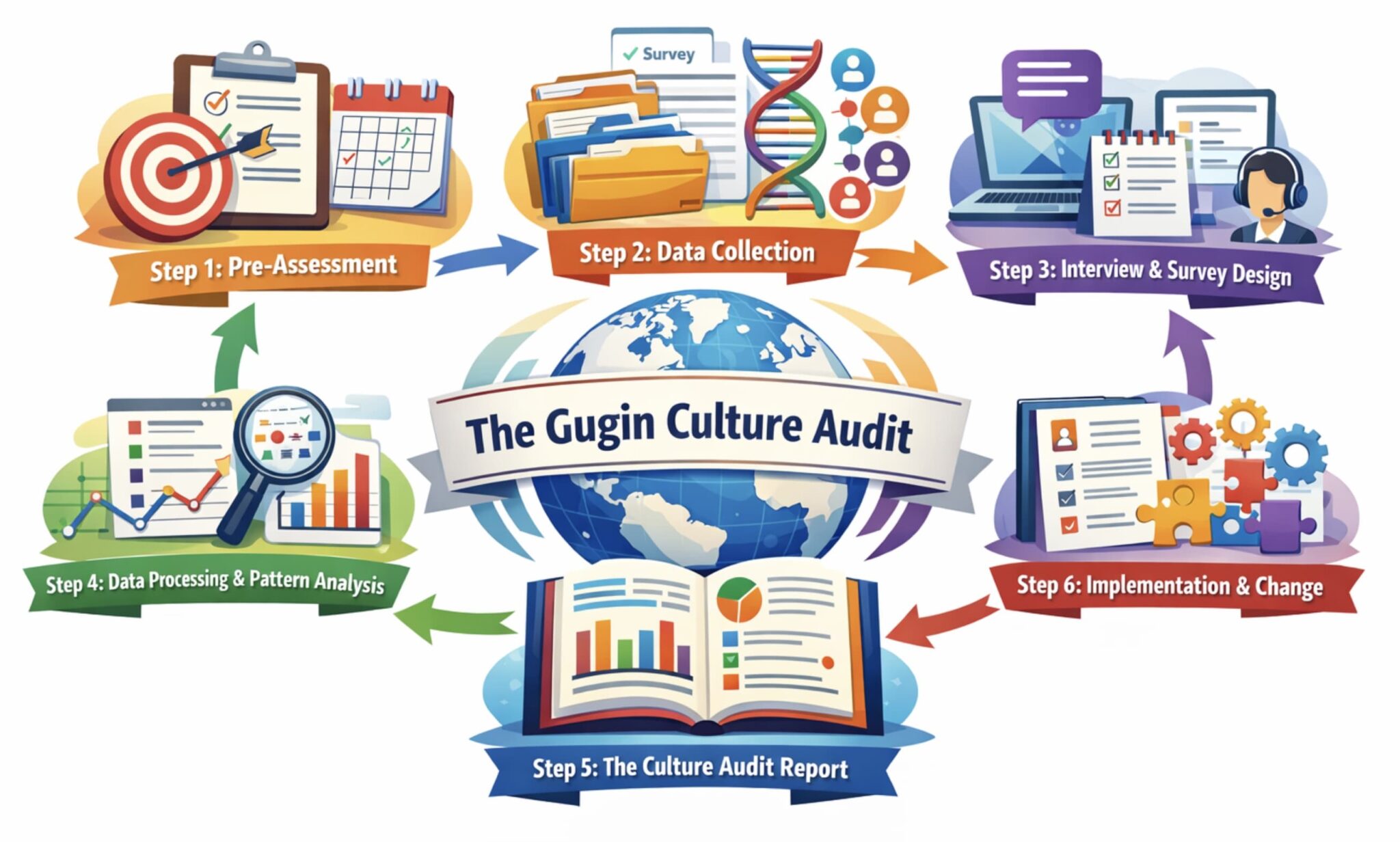
Step 1: Pre-Assessment

Before anything else, Gugin works with you to define the scope and purpose of the audit. Every organisation is different, and every situation — whether a merger, a strategy change, or a performance challenge — calls for a tailored approach. The complexity of your organisation, the timeline, and the key questions you need answered are all agreed upon at this stage.
Deliverable: A customised audit plan with a clear scope, purpose, and agreed timeline.

Step 2: Data Collection

Gugin draws on the data most organisations already have available — employee surveys, exit interviews, external ratings, intranet resources, internal newsletters, and internal statistics. gugin This existing material is reorganised and mapped against the elements of Gugin's Cultural DNA framework. Internal stories, symbols, and heroes also get examined here, as they reveal a great deal about what an organisation truly values.
Deliverable: A structured inventory of your organisation's existing cultural data, mapped to the 17 Cultural DNA elements.

Step 3: Interview & Survey Design

Based on what the pre-assessment and data collection reveal, Gugin creates fully customised surveys and interview guides. Surveys are available on Gugin's extranet and contain a mix of multiple-choice questions, free-form answers, and ratings on a scale of 1 to 5, covering all elements of the Cultural DNA. Interviews can be conducted face-to-face, via video call, or by telephone — with face-to-face recommended where possible, as body language and environmental cues are also observed. gugin
Deliverable: Tailored survey questionnaires and interview frameworks, designed to surface both explicit and implicit cultural behaviours.


Step 4: Data Processing & Pattern Analysis

Once all surveys are closed and interviews completed, Gugin processes and evaluates the data. Survey results are analysed automatically where possible, while qualitative data is manually reviewed and categorised across the Cultural DNA elements. Gugin then looks for cultural patterns and gaps, particularly where a benchmark exists, and invites the client to a preliminary briefing of key findings to gather feedback. gugin
Deliverable: A preliminary findings briefing, including identified cultural patterns, sub-culture differences, and initial friction points.

Step 5: The Culture Audit Report

The full findings are compiled into a comprehensive written report. This is the core deliverable of the entire process — a clear, evidence-based picture of your organisation's cultural reality. The report covers your Cultural DNA in detail and translates the data into specific, actionable insights.
Deliverable: A detailed cultural profile of your organisation (your Cultural DNA)
Identification of cultural patterns and sub-culture differences
Prediction and prioritisation of cultural friction points and their impact on effectiveness
Specific recommendations for reducing or avoiding cultural friction
Recommendations on organisational adjustments
A road map for implementing the recommendations

Step 6: Implementation Planning & Change Process

The final step translates insight into action. The next steps vary depending on why the audit was conducted. If the goal is culture change, Gugin benchmarks the current culture against the ideal and develops change plans for each relevant element. If the goal is cost reduction, Gugin identifies the management layers producing the most cultural friction and develops plans to improve effectiveness — even in situations involving restructuring or redundancies. gugin
Deliverable: A tailored implementation road map with prioritised actions, change plans per Cultural DNA element, and clear guidance on what to address first to protect performance and momentum.
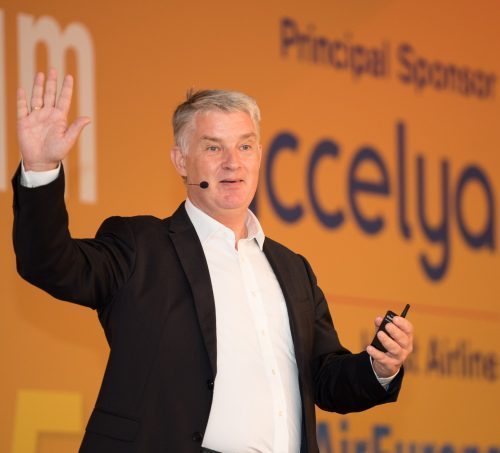
Award-winning keynote speaker ob cross-cultural leadership Finn Majllergaard

Book Dr Finn Majlergaard, CEO Gugin for a speech or lecture in your Company, University or Business school. He teaches at universities and business school across the world and has facilitated hundreds of workshops for more than 600 companies in 25+ countries

Why you should let Gugin conduct a culture audit of your organisation?

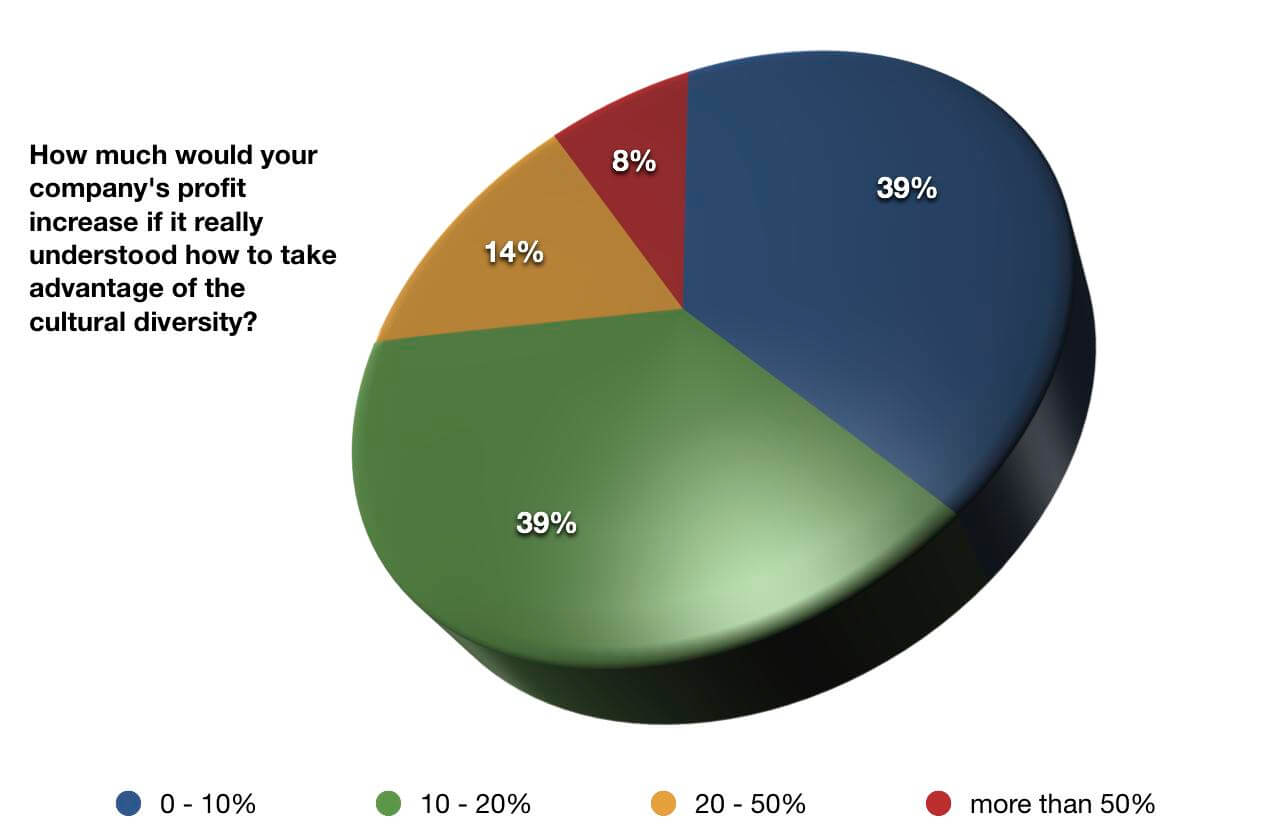
Gugin has conducted a survey among 1200 middle managers with the purpose to find out how important the corporate culture is to them ad what this corporate culture can do for them if it is done right

Here are som questions we usually ask to get an idea of the real company culture

  1. What kinds of behaviour tend to be recognised and rewarded here — and what sort tends to hold people back, even if it’s never openly discussed?”
  2. “Can you think of a time when someone challenged the leadership team? How was it received?”
  3. “If I were to speak to someone who left recently, what might they say about why they moved on?”
  4. “What’s something people often grumble about internally, but that still hasn’t been properly addressed?”
  5. “If you had a magic wand and could change one thing about the culture, what would it be?”
  6. “Tell me about a time someone got something wrong here — how did their team respond?”
  7. “How do key decisions really get made — in formal meetings, or more informally behind closed doors?”
  8. “Can you name someone who seems to be genuinely thriving here — and what do you think is helping them succeed?”
  9. “Who tends to leave, and do any patterns stand out in their reasons for going?”
  10. “How does the organisation recognise when it needs to unlearn habits or processes that no longer work?”
  11. “How safe is it for people to say ‘I don’t know’ or ask for help here?”
  12. “What’s the biggest tension or challenge the leadership team is grappling with at the moment?”
  13. “Tell me a story about this place that would never make it into a recruitment brochure — but that sums up something real about the culture.”
  14. “What’s one of the unwritten rules here that new joiners often discover the hard way?”
  15. “If the company disappeared tomorrow, what do you think your people would genuinely miss?”


Motivation is more complex than most reward systems acknowledge

Many organisations default to financial incentives when performance stalls — bonuses, pay rises, perks. But money alone rarely solves a motivation problem. The reason is simple: external rewards cannot compensate for deeper cultural deficiencies.
When people are disengaged because of poor leadership, a lack of purpose, or feeling undervalued, no financial package will change that. In fact, layering rewards on top of an unhealthy culture often masks the real issue and delays the necessary conversation.
Effective motivation requires understanding what actually drives people in your organisation — and that understanding begins with a culture audit.
Dr Finn Majlergaard explores this further in his interview with TR2050:
Watch the interview
How does Gugin identify the cultural DNA in the corporate cultural audit process?

DNA is a molecule that encodes the genetic instructions used in the development and functioning of an organism. We all have unique DNA. It is our biological identity.

Organisations are similar. They are all unique which is why we use the term the Cultural DNA when identifying and describing a company’s culture. Like the human DNA, the cultural DNA is made of components that have different forms from one organisation to the other.

We describe your organisation’s cultural DNA by assessing each of the elements in the DNA. In our model, we have 17 elements which make up the cultural DNA
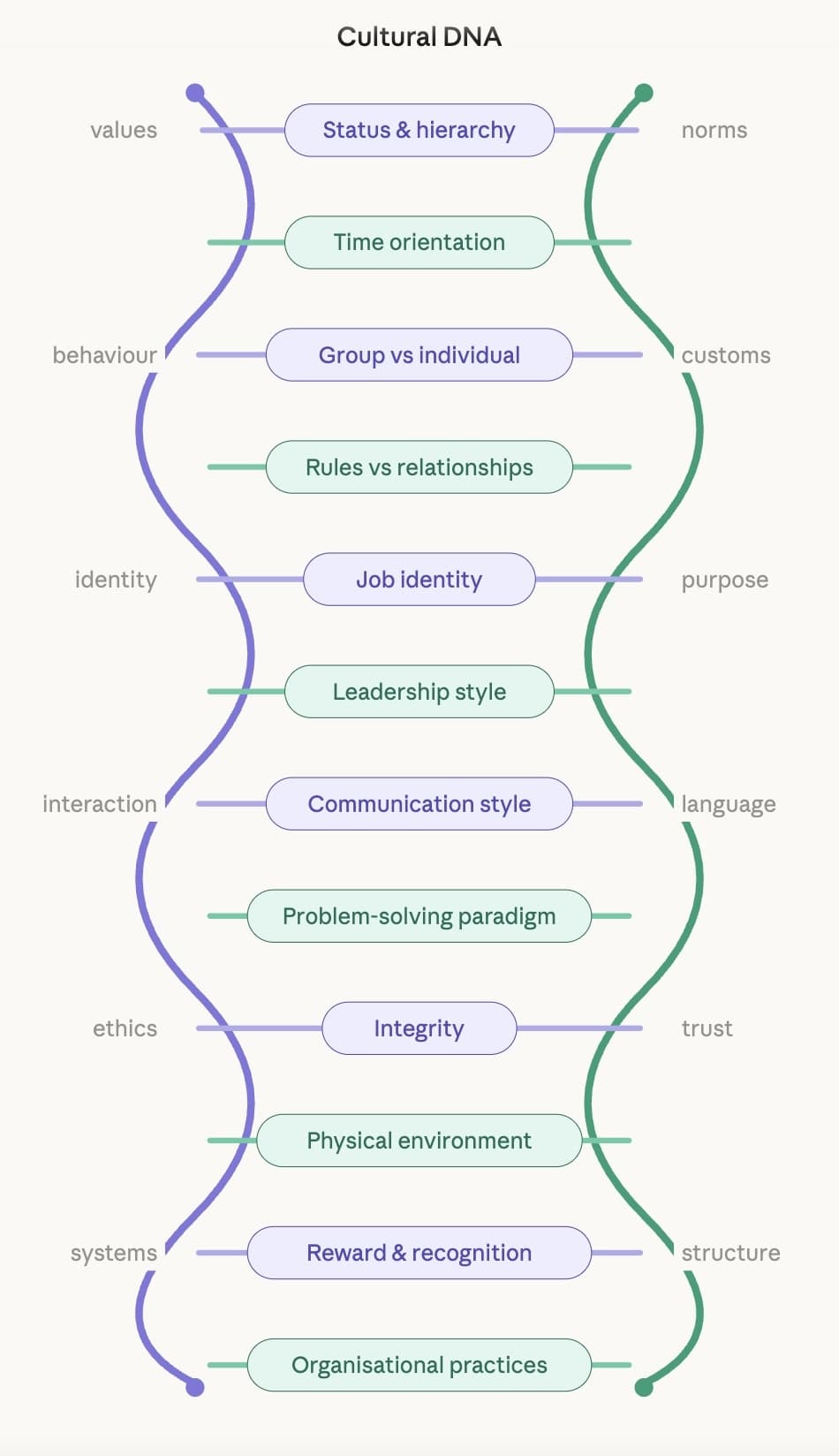
The Gugin Company Culture DNA we use to describe a company culture

Get started with your Culture Audit

Please get in touch with us. We will love to hear why a company culture audit is necessary for your organisation. Then we can share some of our experiences and ideas

What separates a good leader from one who truly moves people? Research — and decades of cultural intelligence practice — point to one word: charisma. And unlike talent, charisma can be learned.

In 1979, Warner Records refused to send Prince on tour. Not because of his music — they knew he was exceptional — but because he lacked charisma. He couldn't yet move an audience. Fast forward one year, and Prince had transformed himself into one of the most commanding performers in the history of popular music. He didn't wait for charisma to arrive. He worked at it, systematically, studying and adopting the techniques of the performers he admired.

That story is not just about rock and roll. It is a precise metaphor for leadership. At Gugin, we have spent over two decades helping leaders across cultures and industries make exactly this kind of transformation — not by telling them to "be more confident," but by equipping them with concrete, learnable strategies rooted in emotional intelligence, cultural intelligence, and communication science.


Why Most Charisma Advice Fails

The most common advice leaders receive about charisma is frustratingly vague: project confidence, be warm, be present. These qualities do matter. But they are nearly impossible to "just do" on command, especially under pressure, across cultures, or in unfamiliar organisational contexts.

Research by Professor John Antonakis and his colleagues at the University of Lausanne Business School has shown that charisma is not a personality trait reserved for the few — it is a set of communicative behaviours that can be identified, taught, and practised. In their studies, randomly selected middle managers who underwent structured charisma training were subsequently rated by peers and subordinates as more charismatic, more competent, and more trustworthy. The training worked.

At Gugin, we have built on this science and gone further — weaving it together with emotional intelligence (EQ) and cultural intelligence (CQ) to create a leadership development approach that is both evidence-based and globally applicable.

The Nine Charismatic Behaviours — And What They Really Require

The Antonakis research identifies nine concrete charismatic leadership tactics: using metaphors and stories, showing moral conviction, expressing shared feelings, setting high expectations, using contrast and rhetorical questions, using lists, and animating communication with body language. These are the building blocks. But building blocks need a foundation — and that foundation is emotional and cultural intelligence.

Take metaphors, for example. A metaphor is only powerful if it resonates with the audience. In Gugin's cross-cultural leadership programmes, leaders quickly discover that a metaphor drawn from American sports culture may fall flat in a team from Northern Europe, and that a story invoking individual heroism may alienate a collectivist audience in East Asia. The charismatic tactic is the same; the cultural calibration is everything.

The same applies to moral conviction. Appealing to shared values is one of the most potent charismatic tools a leader has. But whose values? Which moral frameworks? A leader operating across multiple cultural contexts must understand that concepts like fairness, loyalty, duty, and hierarchy carry profoundly different weight in different cultures. High cultural intelligence — the ability to read, respect, and adapt to cultural difference — is what allows a leader to express genuine moral conviction that actually connects rather than alienates.

Emotional Intelligence: The Inner Architecture of Charisma

Charisma without emotional grounding is performance. It can work in the short term, but it rarely sustains trust. The leaders Gugin works with are taught to understand that emotional intelligence is not a soft supplement to charismatic leadership — it is its inner architecture.

Consider the tactic of expressing shared feelings. Antonakis identifies this as key: when a leader says "I feel the same uncertainty you do, and here is how I am holding it," they build identification and trust. But this requires real self-awareness. Leaders must be able to name and regulate their own emotional states before they can credibly reflect the emotions of others. In Gugin's programmes, we invest significant time in developing exactly this capacity — helping leaders identify their emotional triggers, understand how their inner states broadcast outward, and build the emotional vocabulary needed to communicate with authenticity.

Empathy — a core dimension of emotional intelligence — also directly underpins several charismatic behaviours. Setting high expectations while simultaneously communicating belief in others (another of the Antonakis tactics) requires a leader who genuinely sees the potential in the people around them. That kind of seeing is empathic. It cannot be faked over time. When Prince produced the band The Time for Warner Brothers, he did not simply demand excellence — he made each member believe they were capable of more than they thought. That is emotionally intelligent leadership in action.

Cultural Intelligence: Charisma That Travels

One of the most important — and most overlooked — dimensions of charismatic leadership in today's world is its cultural portability. A leader who is magnetic in one cultural context may be perceived as arrogant, shallow, or inappropriate in another. This is not a flaw in those audiences. It is a signal that charisma, like all communication, is culturally embedded.

Gugin's work in over 60 countries has shown us that the nine charismatic tactics are universal in their structure but must be culturally adapted in their expression. Rhetorical questions, for instance, invite participation and create anticipation — but their delivery must match the power-distance norms of the audience. In high-hierarchy cultures, a rhetorical question from a senior leader may silence a room rather than energise it. In low-hierarchy cultures, it may spark exactly the engagement intended. Cultural intelligence tells the leader which dynamic they are working in, and how to adjust.

Similarly, the use of storytelling — one of the most powerful charismatic tools — varies enormously across cultures in terms of what stories are appropriate, how direct or indirect they should be, and what kinds of protagonists resonate. Gugin teaches leaders to build a culturally diverse repertoire of stories and to develop the sensitivity to know which story belongs in which room.

How Gugin Trains Charismatic Leaders

Gugin's leadership development programmes integrate the science of charismatic communication with structured development in emotional and cultural intelligence. The process is iterative and experiential, not theoretical.

Leaders begin by gaining honest self-awareness: understanding how they are currently perceived, what emotional signals they project under pressure, and how their default communication style reads across cultures. This foundation phase often surfaces important blind spots — the technically brilliant executive who speaks too abstractly to inspire, the empathetic manager whose conflict-avoidance reads as a lack of conviction.

From there, leaders move into skill-building: practising charismatic communication tactics in safe, structured environments with real feedback. They learn to craft metaphors that carry cultural resonance, to tell personal stories that build connection without oversharing, to use contrast and rhetorical structure to sharpen their message. They receive coaching on non-verbal communication — the body language, vocal variety, and presence that Antonakis identifies as essential to bringing charisma alive.

Finally, leaders apply these skills in live contexts, with coaching support, and receive 360-degree feedback that tracks their progress. This mirrors the approach Antonakis found to be effective — group training combined with individual coaching — and embeds it within the broader cultural and emotional intelligence framework that makes the development durable and globally relevant.

Charisma as a Leadership Responsibility

There is a deeper point worth making. Charisma is not about making yourself more impressive. At its best, it is about making others feel seen, energised, and capable of more than they believed. It is about communicating in a way that bridges difference, builds shared purpose, and creates the conditions for people to do their best work.

In a world where leaders must navigate unprecedented complexity — technological disruption, geopolitical volatility, multi-generational and multicultural workforces — the ability to communicate with clarity, conviction, and emotional resonance is not optional. It is a strategic capability.

Prince didn't work on his charisma because he wanted to be famous. He worked on it because he knew, instinctively, that the music mattered — and that without the ability to connect, the music would never reach the people it was meant for.

The same is true of leadership. The work matters. Charisma is what carries it across.


About Gugin  |  Gugin is a global advisory firm specialising in cultural and emotional intelligence. We help organisations build the leadership capability to thrive in a complex, multicultural world. Learn more at www.gugin.com

error: Content is protected from theft